
Bas de la page
Louis Charbonneau
UQAM
La Renaissance
1453-1600
Ligne
du temps
Carte historique
 |
Jacques Cartier, qui a découvert le Canada en 1534. |
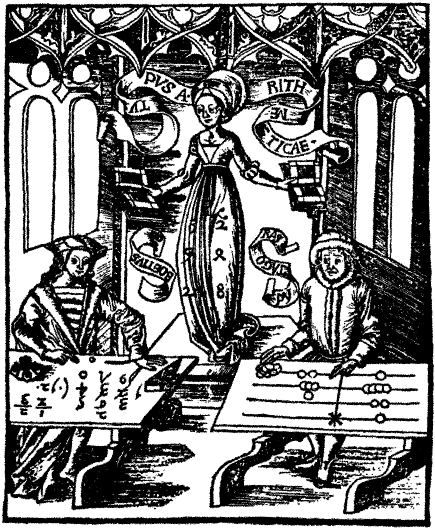
L'Arithmétique. Gregor Riesch, Margarita Philosophica, 1503.
Extrait de Menninger, Karl, Number Words and Number Symbols, A Cultural History of Numbers, Cambridge, Mass. : M.I.T. Press,1977, p. 350
et dans Richard Mankiewicz, L'Histoire des mathématiques, Paris : Seuil, 2001, p. 73.
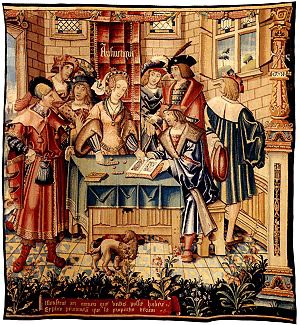
L'Arithmétique, Tapisserie, vers 1520
Musée des Thermes et de l'Hôtel de Cluny, maintenant Musée national du Moyen Âge , Paris.
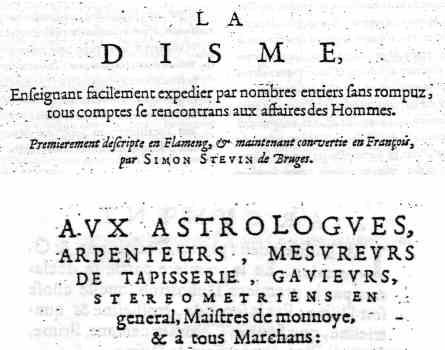
Première page de La Disme de Simon Stevin (édition de 1585)
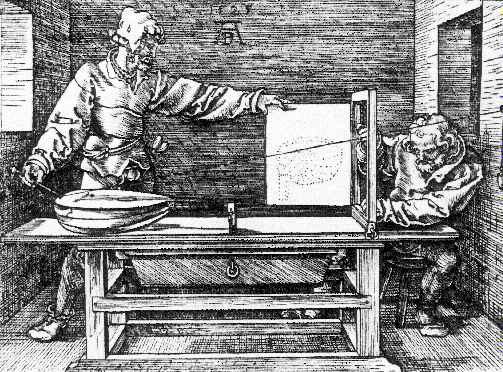
Dürer - 1525
Kline, Morris, Mathematics, A Cultural Approach, Reading, London : Addison-Wesley. 1962, p. 215.
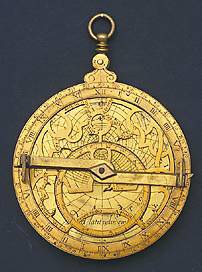
Astrolabe, XVIe siècle
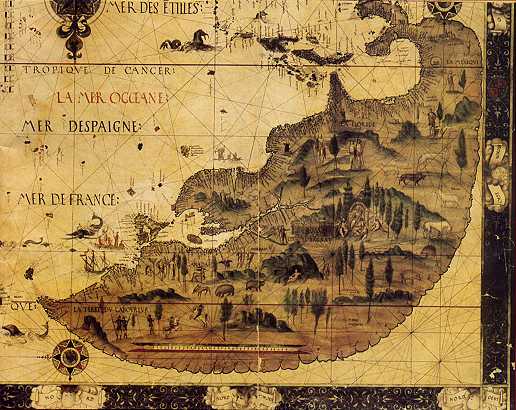
Carte de l'Amérique du nord par Pierre Desceliers, 1546.
Jeffrey S. Murray, Fanciful Worlds, How strange beasts
and myths found their way onto early maps, Canadian Geographics,
sept./oct 93, p. 65.
Archives nationale du Canada, NMC-40461.
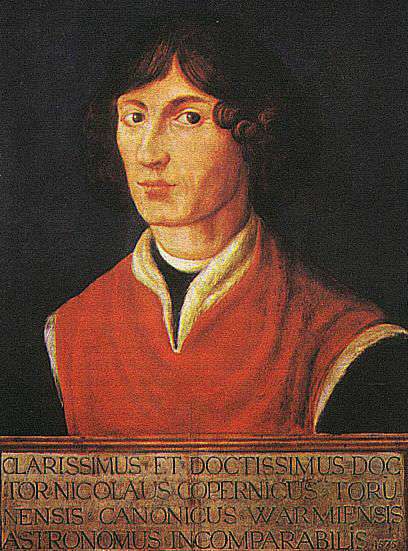
Copernic (1473-1543)
Hugh Kearney, Science and Change, 1500-1700, New York : McGraw-Hill, 1971, p. 102.

Le modèle astronomique de Copernic (1543)
Alexandre Koyré, La révolution astronomique, Paris : Hermann, 1961, p.65
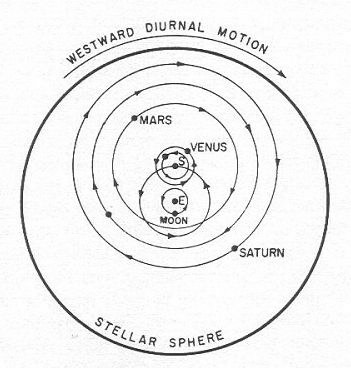
Modèle astronomique de Tycho Brahe (1546-1601)
Khun, Thomas, The Copernican Revolution, Cambridge :Harvard Univ. Press, 1957, p. 202.
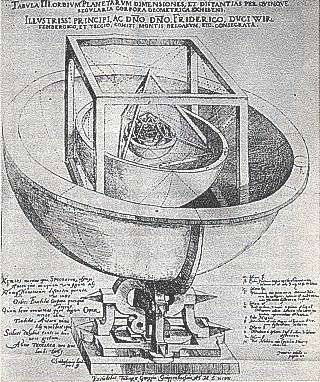
Kepler, Mysterium Cosmographicum, 1596
Hugh Kearney, Science and Change, 1500-1700, New York : McGraw-Hill,1971, p. 134.

Vers une vision mécanique de l'univers
http://www.noe-education.com/D121.htm#divers
Mathématiques et sciences
-
Vers les décimaux.
-
Les projections géométrique pour la construction des cartes géographiques.
-
Vers une arithmétique des symboles : l'algèbre
(Ligne tu temps sur l'algèbre)-
Surabondance des règles
-
Réduction du nombre de règles
-
règle des premiers : confondre ce qui est semblable
-
recherche d'une notation efficace (dire beaucoup en peu de symboles)
-
-
Nombre (symbole) sans mémoire : L'algèbre devient indépendante de la géométrie.
Dés-homogénéisation des expressions
-
-
Vers un univers infini... et homogène.
-
Quelques noms
-
Christophe Colomb (1451-1506), Leonardo da Vinci (1451-1519), Albrecht Dürer (1471-1564), Andress Vesalius (1514-1564).
-
Martin Luther (1443-1546), Nicolas Copernic (1473-1543), Niccolo Tartaglia (1500-1557), François Viète (1540-1603), Tycho Brahe (1546-1601).
-
 |
 |
 |
 |
 |
 |
 |
 |
 |
 |
 |